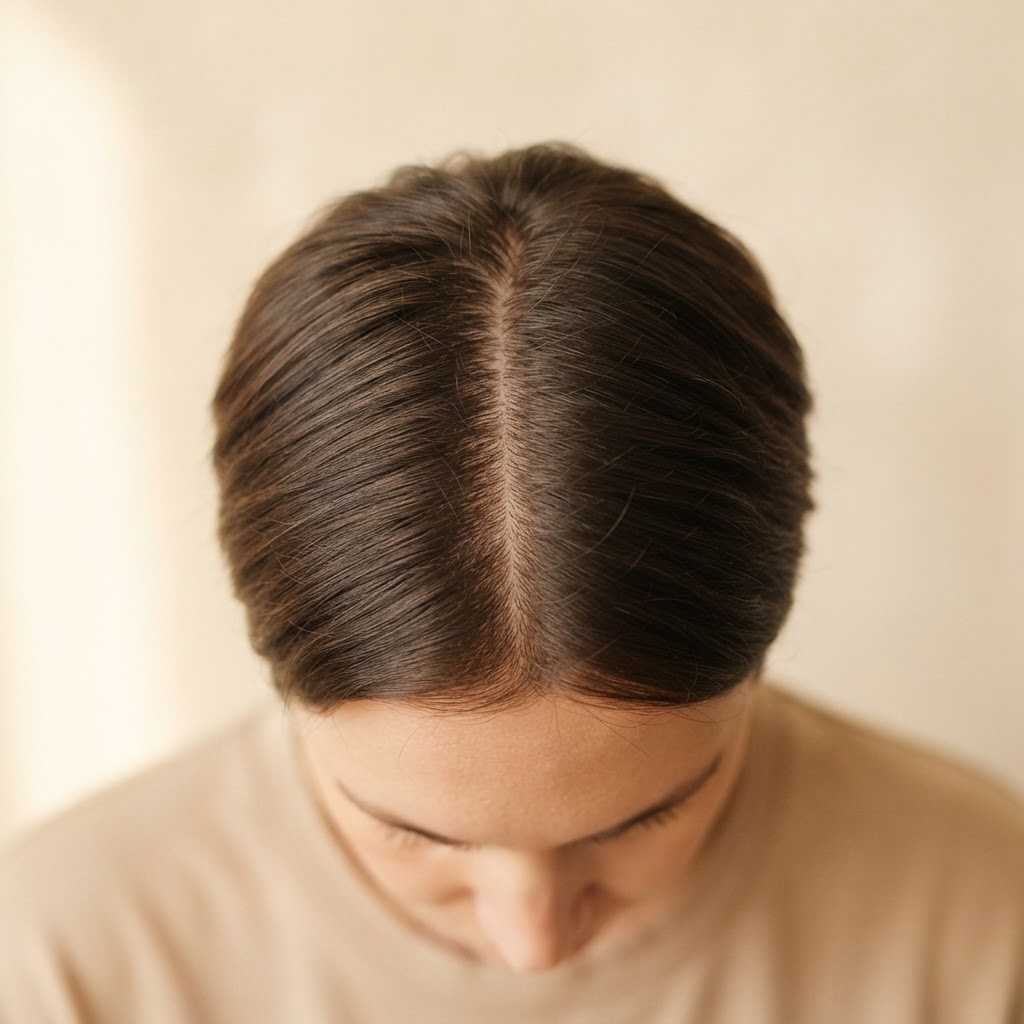



Hair loss is a symptom, not a diagnosis. That one line is the most useful thing a doctor can say about it, because everything that follows depends on which cause you have. Two women with identical thinning at the parting can need completely different plans. One is having a reversible shedding episode that began three months after childbirth. The other has genetic pattern loss that has been quietly progressing for six years. A treatment that helps the second will do very little for the first if it is started at the wrong moment, and the reverse is just as true.
So this is the guide we would give a patient who asked us everything in one sitting: what actually causes hair loss, why it so often starts after pregnancy or a long trip abroad, what changes with age, and how the two regenerative pathways we use in clinic differ.
First, the biology in one paragraph
Every hair follicle cycles through three phases. Anagen is growth, and it lasts years. Catagen is a short transitional phase. Telogen is rest, at the end of which the hair sheds and a new one starts. At any moment roughly nine in ten of your follicles are in anagen, which is why most people have a full head of hair most of the time. Hair loss happens in only two ways: the cycle is disturbed, so too many follicles enter telogen at once, or the follicle itself is being miniaturised or destroyed, so the hair it produces gets finer and shorter until it stops appearing at all. The first is usually reversible. The second needs to be interrupted early, while there is still a follicle to save.
1. Pattern hair loss: the most common cause, by a distance
Androgenetic alopecia accounts for the overwhelming majority of cases in both men and women. It is genetic and hormonal. Dihydrotestosterone, a normal by-product of testosterone, gradually shortens the growth phase and miniaturises the follicle, so each hair grows back thinner and lighter until the scalp shows through. In men the pattern starts at the temples and crown. In women it is usually a slow widening of the parting and a loss of overall density, with the frontal hairline preserved.
What matters clinically is that pattern loss is progressive. It does not plateau by itself. It also happens alongside other causes, which is why a woman in her forties can have genetic thinning made suddenly much more obvious by a stressful year.
2. Reactive shedding: pregnancy, travel, illness and crash diets
Telogen effluvium is the second most common thing we see, and it is the one that frightens people most because it arrives quickly and in volume. A shock to the system pushes an unusually large number of follicles into the resting phase at the same time. Because telogen lasts around three months, the shedding appears about twelve weeks after the trigger, not at the time of it. Patients almost always connect the hair loss to the wrong event as a result.
Common triggers we take a history for:
- Childbirth, typically three to six months after delivery
- A significant illness, surgery or general anaesthetic
- Rapid weight loss, including weight lost on appetite-suppressing medication
- Restrictive dieting, low iron stores, low vitamin D or an underactive thyroid
- Sustained emotional stress or a period of poor sleep
- Long-haul travel, especially to hot and humid destinations
Why hair falls out after a trip to Bali
Post-holiday shedding is real, and it is one of the most common things patients apologise for asking about. Nobody returns from Bali with hair loss because of Bali. What happens is a stack of small physiological stresses arriving together: a change in diet and routine, dehydration, disrupted sleep and jet lag, sometimes a stomach upset or a low-grade illness picked up while travelling, and sun exposure on a scalp that has not seen daylight for months. Add hard water, salt water and chlorine, and the hair you have can feel rougher and look thinner before any of it sheds. Three months later the shedding starts, right when the holiday feels like a distant memory.
The reassuring part: if the scalp is healthy and the trigger has passed, telogen effluvium recovers on its own. The useful part of a consultation is checking that nothing else is running underneath it, because low iron, thyroid disease and pattern loss all look identical in the mirror and only one of them resolves by itself.
3. Alopecia areata: the immune system at work
Alopecia areata is an autoimmune condition in which the body attacks its own follicles, producing sudden, smooth, round patches of hair loss, sometimes with a stinging or tingling sensation beforehand. It can affect the scalp, beard, eyebrows and eyelashes. It is not caused by stress or by a shampoo, although stress can worsen it. It is a medical diagnosis and often needs a specialist referral, and it behaves very differently from the other causes on this list.
4. Traction alopecia: mechanical, and preventable
Tight ponytails, braids, extensions and heavy clip-ins pull on the follicle for years. Early on the loss is reversible. Left long enough, the follicle scars and the loss becomes permanent along the hairline and temples. If you wear your hair up tightly most days, loosening it is the single most effective treatment available, and no injectable can undo scarring once it has formed.
5. Age, the perimenopause and the menopause
Hair thins with age for several reasons at once. Follicles spend fewer years in growth, so density falls; the hair shaft itself becomes finer; and the scalp produces less sebum, so hair looks and feels drier. Around the perimenopause, falling oestrogen and shifting androgen levels change the ratio that has protected the follicle, which is why so many women first notice real thinning in their late forties and fifties, often alongside a widening parting. It is extremely common and it is treatable, but the plan is a long one rather than a course of four sessions.
6. Scarring alopecia: the diagnosis that must not be missed
A small number of people have inflammatory scarring conditions such as lichen planopilaris or frontal fibrosing alopecia, where the follicle is permanently destroyed and the scalp can look red, flaky or shiny at the edges of the loss. Regenerative treatments are not the answer here, and using them can delay the treatment that is. This is why we assess before we treat, and why we refer rather than sell.
How we work out which one you have
A scalp consultation with a doctor is not a sales appointment. It is a short piece of clinical work:
- The pattern and distribution of the loss, mapped and photographed for comparison later
- Magnified examination of the scalp and hair shafts to look for miniaturisation, inflammation and scarring
- Your history: pregnancy, illness, weight change, medication, styling habits, family pattern
- Bloods where they would change the plan, most often iron studies, thyroid function, vitamin D and, in women, hormones
- An honest answer about whether treatment is likely to help, and what it will cost
The two regenerative pathways: PRP and LaseMD Ultra
Once we know the follicle is still alive, the aim of treatment is the same whichever route you take: increase blood supply to the scalp and deliver signalling molecules to the hair bulb so that follicles return to the growth phase and stay there longer. We offer two routes to that, and patients choose between them mostly on how they feel about injections.
PRP: your own growth factors
Platelet-rich plasma is prepared from a small sample of your own blood, spun down to concentrate the platelets and the growth factors they carry, including VEGF and PDGF. Your doctor places that concentrate into the thinning areas of the scalp, where it triggers new blood vessel formation and cell proliferation around the follicle. Because it is your own tissue and because it is placed into the scalp, it is performed with full aseptic technique, exactly as any other procedure involving blood products should be.
PRP is the more established of the two routes, has the deeper evidence base, and typically produces the more noticeable change in density in pattern hair loss. It is a course rather than a single appointment, usually three sessions about four weeks apart, then maintenance.
LaseMD Ultra: no injections at all
LaseMD Ultra is a fractional thulium laser. It creates microscopic channels at the surface of the scalp without breaking the skin with a needle, and doctor-applied growth-factor serums are then absorbed through those channels. It is comfortable, there is no downtime to speak of, and for anyone who genuinely cannot face injections it makes a regenerative pathway possible where they would otherwise have none.
It is the right choice for some patients and the wrong one for others, and we will say which at consultation rather than letting the answer be decided by preference alone.
Which one, and can they be combined
Pattern loss with good density elsewhere usually starts with PRP. Very sensitive scalps, needle aversion, or early thinning where the priority is scalp health rather than volume often start with LaseMD Ultra. Where the loss is more advanced, or where a patient wants the strongest plan we can offer safely, we combine them across a short course and review the response as we go.
Where polynucleotides and exosome therapy fit
Polynucleotides are highly purified DNA fragments that act as biostimulators. They improve the microenvironment of the scalp and reduce the low-grade inflammation that accelerates hair loss, and they are a useful adjunct for a scalp that looks inflamed or reactive. Exosome therapy carries cell-signalling instructions into the scalp, and is usually chosen where loss is more advanced or alongside PRP as part of one programme. Both are supportive rather than a replacement for a diagnosis, and both work best on a scalp that has been properly assessed first.
What we will not do
We will not treat a scarred, shiny area of scalp that has no living follicle, because nothing injectable will bring it back. We will not promise regrowth: hair responds slowly, results vary between patients, and no outcome is guaranteed. We will not treat a scalp we have not examined. And we will not sell a course of six sessions to someone whose bloods show an untreated iron deficiency, because that is the actual problem.
What the timeline really looks like
Anyone offering you visible change in a fortnight is not describing hair. Density builds over months, and the honest sequence runs roughly like this. Consultation and assessment first. First treatment session within a week or two. A settling phase in weeks two to six, when some shedding can still happen before improvement starts. Real, photographable change between months three and six. Then maintenance every three to six months for as long as you want to keep the result.
Hair is the slowest tissue we treat. Which is exactly why the diagnosis is worth getting right at the start.
Where to start
If you are losing hair in Manchester, the consultation is a one to one scalp assessment with a GMC-registered doctor: the pattern and stage of your loss, your history, an honest view of what treatment can realistically achieve, and a plan agreed with you before anything begins. You can book a hair consultation, read more about our hair restoration treatments, or see published prices before you come in.
This article is general information written by a doctor, not a diagnosis, and not a substitute for an examination. Individual results vary.